Smartsheet vs Excel vs Rows: Which One is Better in 2026? (Updated version, with benchmark)


If you’re on a hunt for the best spreadsheet software that can help you analyze and visualize data, I’ve got three tools for you to try – Smartsheet, Excel, and Rows.
But which one of these three will best help your business? To know, you must analyze these software’s features, pricing, integrations, and more.
To make things easy for you, I went ahead and tested these tools for you.
Here’s what I found:
Use Smartsheet if you want to collaborate with your team and external parties (clients and customers) to solve project management and data pipeline tasks through GANTT charts, kanban boards, etc.
Use Excel if you need to manipulate and run in-depth analyses of large datasets. Excel also gives you access to the biggest and more granular catalog of functions and formulas.
Use Rows if you are a business team who wants to acquire full autonomy often its data. If you happen to often paste data or import files from many of third party tools to a spreadsheet to analyze and share. It comes with 50+ built-in data integrations, AI copilot , and beautiful sharing options.
For an in-depth comparison, read ahead.

Your new AI Data Analyst
Extract from PDFs, import your business data, and analyze it using plain language.
Try Rows (no signup)Features: Smartsheet vs Excel vs Rows

Rows is your new AI Data Analyst. It combines the backbone of a spreadsheet with the power of ChatGPT to to give business people full autonomy over their data. Just ask in plain language and Rows will handle the rest, whether that's spreadsheet operations, data import or transformations, or running Python code to do code-level analyses.
It’s the new way teams at HP, AWS or Taxfix make sense of their data and speed up decision processes.
Let's dive into its features.
AI Analyst
Rows copilot works across four key capabilities:
Spreadsheet-native operations: Standard spreadsheet tasks are supported both as regular commands and via AI —pivots, conditional formatting, new columns, charts—happen through conversation instead of clicking through menus or writing formulas.
Example prompts:
→ "Build a pie chart showing share of profit by product"
→ "Add conditional formatting rule to column D: red if <100, yellow if <150 and green if >150"
Data Ingestion: Pull data directly from documents or connected tools without wrestling with configurations or manual copying-pasting.
Example prompts
→ "Import all transactions from my N26 account and classify them as: marketing, software, travel, other"
→ "Pull keyword data from the last 90 days from Google Search Console"
Multi-step plans: String together multiple dependent steps—build a dashboard, create a calculator from scratch, or execute a series of operations where each step builds on the last.
Example prompts:
→ "Add a column classifying keyword position into brackets: [1-3], [4-10], [10+], then create a pivot showing average CTR by bracket"
→ "Build a simple dashboard showing the performance of sales people in the last quarter"
Code-level analysis: When you need statistical analysis, machine learning, or custom visualizations that go beyond standard charts, Rows can write and execute Python code to get there.
Example prompts:
→ "How does my revenue change if my margin increases by 5%?" (what-if analysis)
→ "How many orders do I need to hit $100k, $500k, and $1M in revenue?" (goal-seek)
→ "Calculate correlation between keyword position and clicks, then show statistical significance"
→ "Run a k-means clustering model to segment customers by purchase behavior and visualize the clusters"
→ "Create a Sankey diagram showing traffic flow from source → landing page → conversion"
Instead of switching between tools or learning specialized syntax, you describe the analysis you want and the AI Analyst figures out how to execute it: it scans your dataset, understands the key variables, and provides what you need.
To access AI in Rows you can either
click on the ✨ icon, at the bottom right corner of your viewport: this will open a chat UI panel that will work across your spreadsheet. You can ask questions in two modes, Build or Chat, based on whether you want to actually creating elements or just have in-line answers.
use the ✨ icon at the top right corner of each element: a contextual menu with a few shortcut will open right away allowing you to perform quick actions like summarizing the content or beautify a table
Watch below side-by-side comparisons with Excel:
Running over 50 prompts on real-world datasets in our benchmark, we found that AI in Excel (and Google Sheets) consistently underperformed across five key dimensions:
Core spreadsheet operations: structuring columns, applying logic across ranges, and keeping spreadsheets clean and traceable.
Accuracy: often giving incorrect or incomplete results, far below competitors
Static output: producing hardcoded numbers, pasted tables, or chart images instead of live, recalculating formulas and linked data.
Advanced analytics: scenario modeling, dataset relationships, clustering, and complex transformations frequently fail or need heavy manual fixes.
Generative requests: Consistently fails at creating predictive or analytical models, even after multiple attempts.
Extract data from documents and images
As mentioned above, Rows can ingest data directly from documents and images—not just as static imports, but as structured, editable tables.
It works with PDFs and multiple image formats (JPEG, PNG, HEIC...)
You can process batches at once rather than uploading files one by one.
All extracted data can get merged into a single table you can immediately work with, stay on separate tables or get appended to an existing one.
You can also add custom extraction instructions to pull exactly what you need. A very common use case is invoices management. By adding the prompt
"Extract date, vendor name, VAT amount, total amount, and description", Rowswill scan all documents and return a consolidated table with those specific fields—no manual data entry, no error, or formatting issues
Instructions can be enhanced automatically and saved for later. Watch the demo below:
What's more? 50+ data integrations
As anticipated above, Rows comes with 50+ built-in data sources integrations in various domains, many of which are supported in the AI Analyst, meaning that you can simply ask AI to pull data from your ideal source and it will take care of the rest.
Example of prompts:
SEO data: "
Pull page data from the last 30 days from Google Search Console, including only pages that contain /blog/"Finance data: "
Pull all transactions from my HSBC account and classify them into: software, marketing, travel expenses, revenue"Marketing data: "
Use GA4 data to rank the top sources of traffic from mobile in Brazil in the last 30 days"
See it in action below:
Here's a division of the built-in integrations in Rows:
Marketing: GA4, GSC, Facebook, Instagram, Tiktok
Finance: Stripe and Plaid (+12,000 supported banks)
Productivity software: OpenAI, Notion, Slack, Email, Translate
Data warehouse: MySQL, BigQuery, PostgreSQL, Snowflake, Amazon Redshift
Discover the full catalog here.
You also have the possibility of creating custom connections via our HTTP functions.
💡 Pro tip: When the tool you’re working with isn’t listed in our catalog, HTTP functions allow you to connect to any RESTful API, GraphQL endpoint, or other HTTP-based data sources, regardless of their structure or authentication methods. On Rows, GET, POST, PUT, and PATCH make the catalog of integrable tools virtually infinite. Try them our in our HTTP tester. Or watch the demo below:
Smartsheet
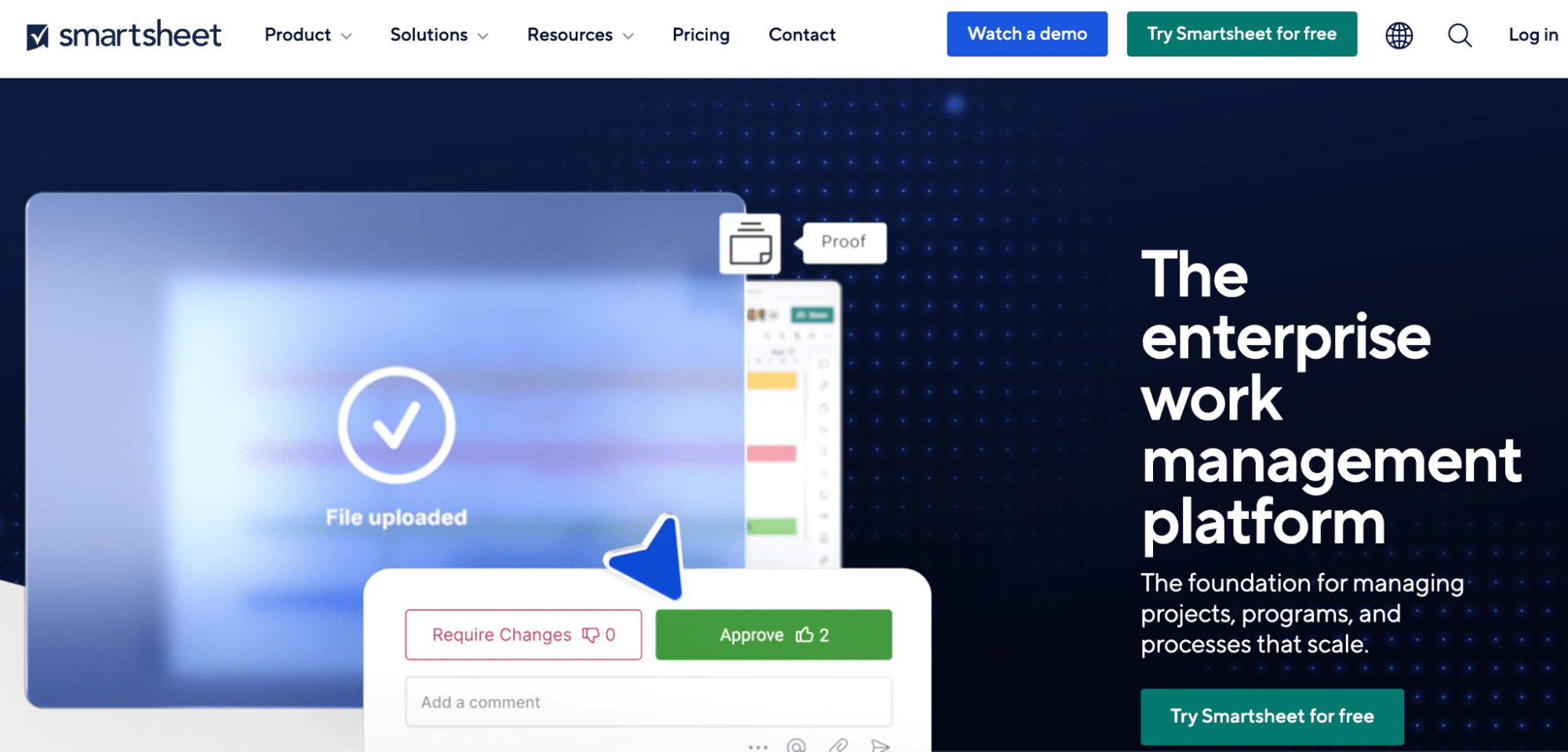
Smartsheet is a cloud-based spreadsheet software that lets you and your team plan, capture, manage, automate, and report on work at scale.
It offers features like dynamic sheets, dashboards, Gantt charts, and forms to streamline processes and improve collaboration.
Automation
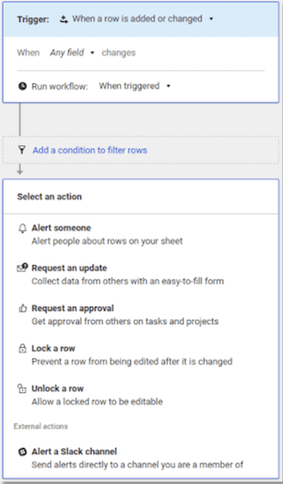
Smartsheet lets you streamline your tasks with no-code workflows. You can set up workflows with multiple actions and conditions across devices.
The software comes with ready-to-use templates you can use as a starting point; it also gives you the option to build a workflow from scratch.
What’s more, Smartsheet also allows you to set recurring or one-off workflows and respond via apps, emails, or Slack.
If you have an Enterprise license of Smartsheet and a DocuSign account, you can create custom PDFs, automate form processes, prepare contracts, and sign documents inside Smartsheet.
Artificial Intelligence
Smartsheet has several AI capabilities that help you analyze and summarize data.
You get instant insights into your business and answers to all your data-related questions with AI-generated charts and metrics.
The tool saves you time by analyzing your sheet data, crafting ad copy, running sentiment analysis, translating text, summarizing task status, and more.
You can also use AI to generate complex formulas by writing instructions in plain, simple English.
Some of the AI features yet to launch are:
Build assistant: Lets you co-build powerful automations.
Portfolio insights: Visualize the status of programs and portfolios through simple conversations.
People insights: Helps you align people and work faster to increase productivity with AI-assisted reporting.
Team Collaboration
Smartsheet offers you one of the best team collaboration features as a spreadsheet software.
Proofing
Proofing helps you request, gather, and manage shareholder input through an intuitive interface. Reviewers can pin comments onto the data visualizations, which can be in the form of images, notes, or documents.
Sharing
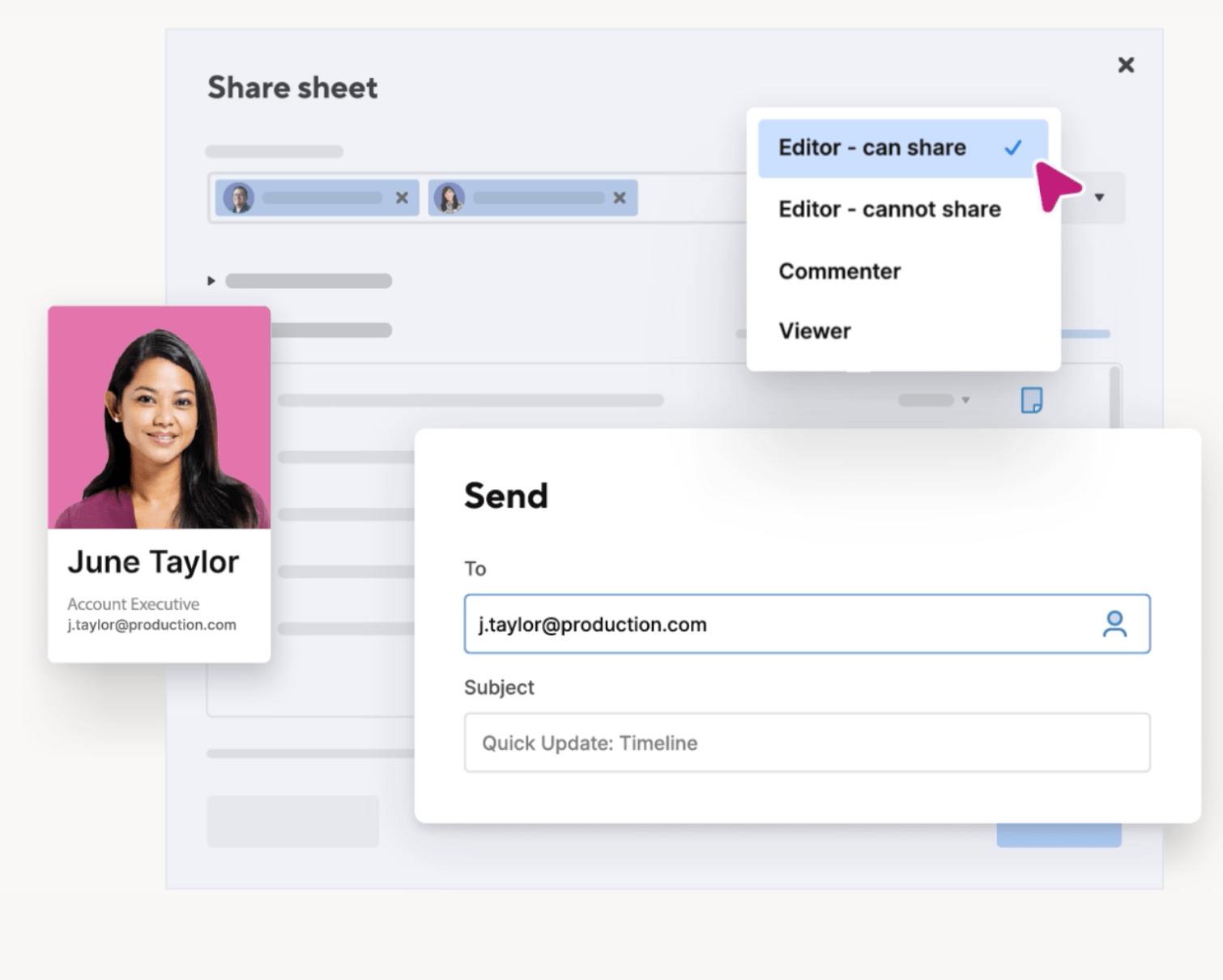
Give collaborators inside and outside your organization access to the most current version of data and visualizations. Smartsheet lets you control access levels. You can allow a person to view only, comment on, or edit the sheet. The best part? Collaborators can share Smartsheet documents without signing in or even having a Smartsheet account.
Attachments
Smartsheet lets you upload several file types – JPG, PNG, GIF, PDF, Docs, XLSX, and more. You can attach these files from Brandfolder, Google Drive, One Drive, and other such platforms.
Dashboards and Reporting
Smartsheet’s dashboards allow you to arrange reports and charts in a single interface, providing real-time insights and updates as data changes.
You can share these dashboards with stakeholders and control permission to ensure data security when collaborating.
Smartsheet also offers customizable report templates or the option to build reports from scratch, ensuring that reports align with specific project requirements. Reports can be built to display data from multiple sheets, consolidating information into a single view.
Lastly, you can use conditional formatting to highlight critical data points, such as overdue tasks or budget variances, with color-coded formatting.
Excel
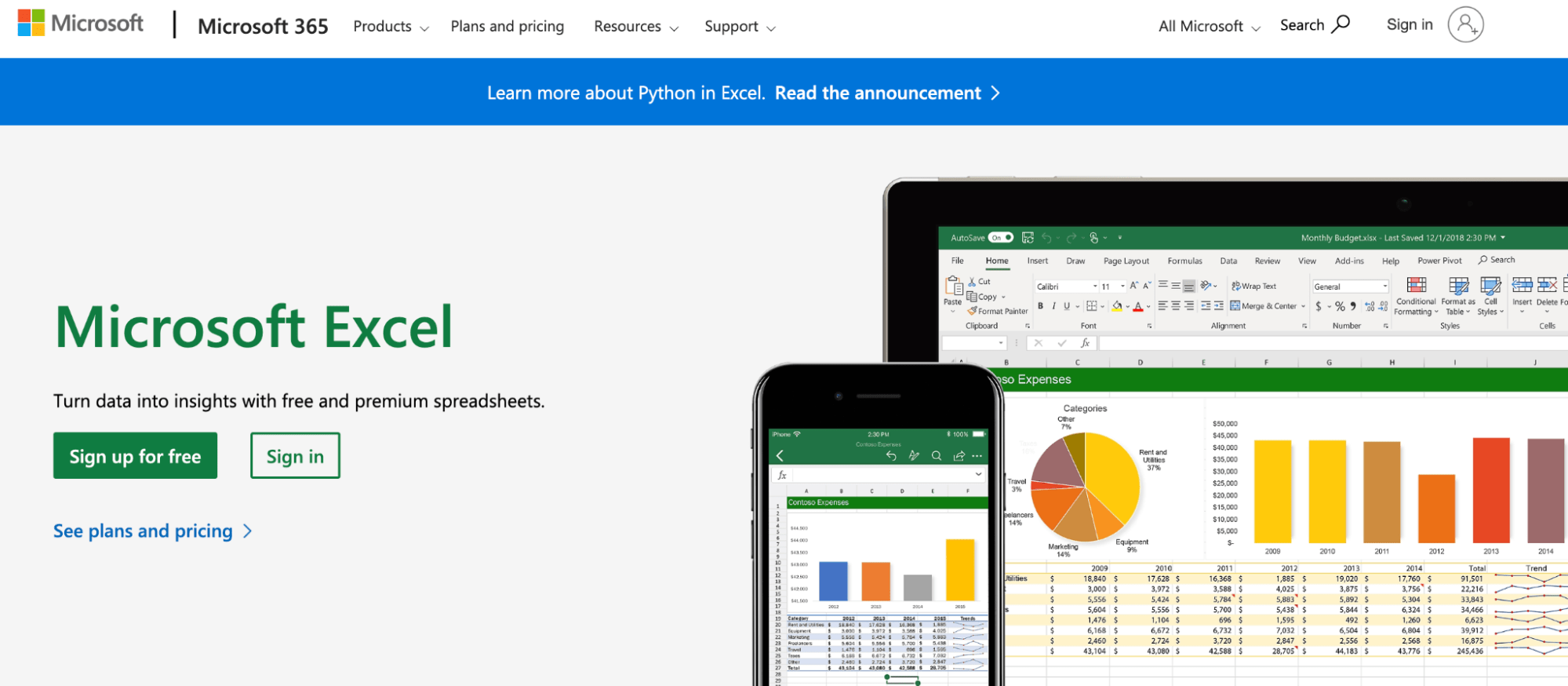
Microsoft Excel is a powerful spreadsheet program for organizing, analyzing, and visualizing data. It provides various tools and functions for calculations, formatting, and data manipulation.
Functions and Formulas
Of the three, Smartsheet, Excel, and Rows, Excel has the largest catalog of formulas and functions (more than 500). So, if your data analysis is heavily based on complex and frequent calculations, Excel is an excellent choice for you.
Copilot in Excel
Copilot is the AI Microsoft has integrated into Excel to make it easy for you to analyze, understand, and visualize data.
You can use Copilot to build graphs and charts from raw data to understand it better.
Copilot also helps you with tasks like formatting, organizing, or cleaning data.
However, unlike Rows, which provides AI capabilities with no added cost, Copilot is an add-on that you have to pay for if you want to use it inside Excel.
Data Analysis
Apart from Copilot, Excel also lets you auto-fill cells, update cell values, and carry out conditional formatting to ease the data analysis process.
Another way of automating recurring tasks with Excel is to create macros and speed up the process via automation. However, compared to Rows and Smartsheet, Excel’s automation capability isn’t something to brag about.
One good thing I observed is that Excel's advanced features go beyond what Smartsheet and Rows offer in terms of functionality.
For example, advanced statistical tests such as z-tests, t-tests, and ANOVAs are built into the platform.
It's no wonder Excel is the preferred choice for analyzing large datasets that require complex formulas, functions, and processes.
Data Visualization
Excel offers customizable graphics and data visualization elements like pie, line, column, bar charts, area and scatter graphs, and other templated options.
It also has a Quick Analysis tool that automatically selects the best chart for your data. In addition, you've access to a vast gallery of ready-made dashboard and report templates for inventory, budgeting, and other versatile purposes.
Integration: Smartsheet vs Excel vs Rows
Rows
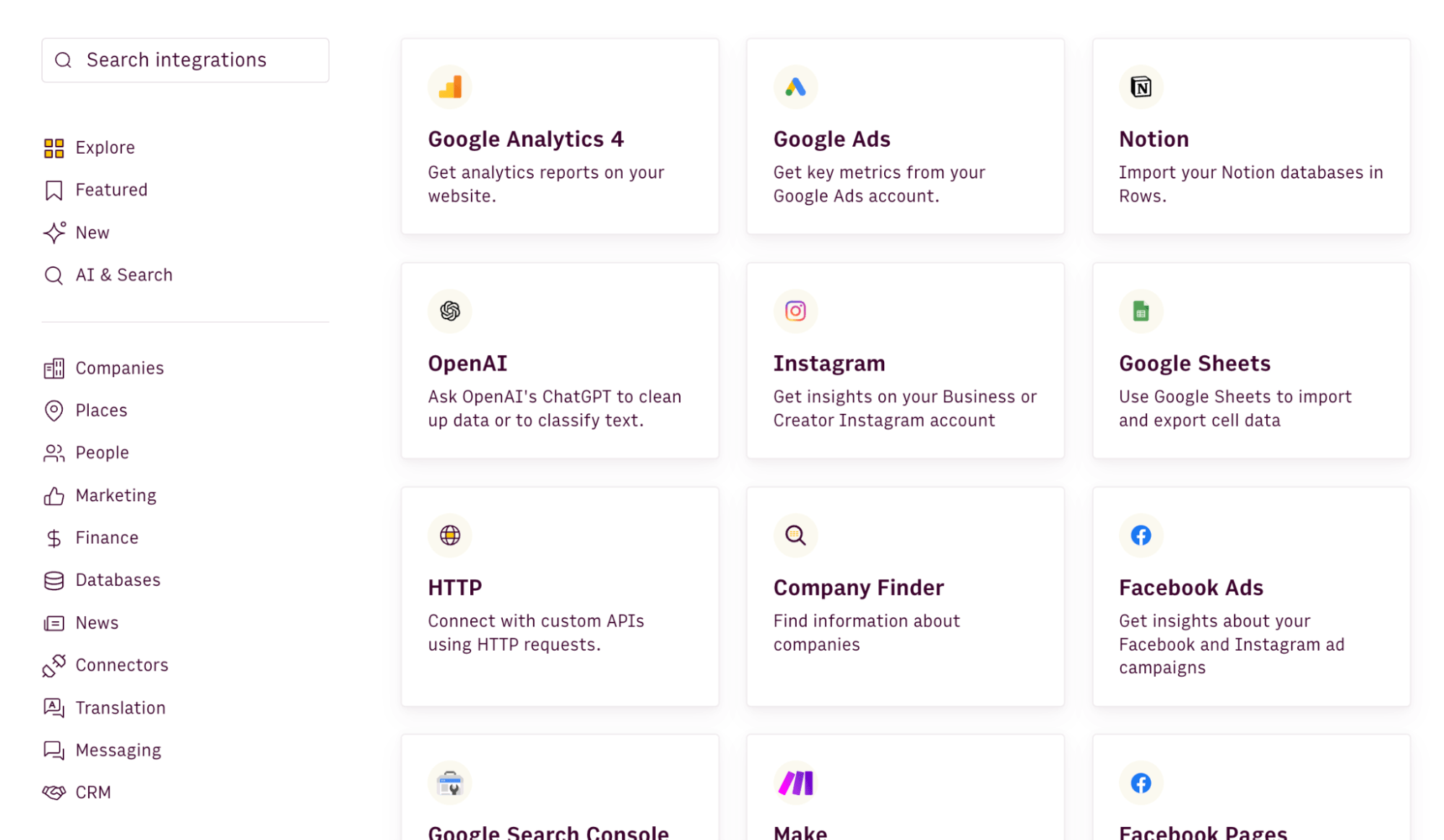
Rows integrates with 50+ data sources, helping you import, automate, and visualize data more effectively.
It integrates with software in categories like finance, marketing, databases, AI, CRMs, and more, such as Google Analytics, Google Search Console, Facebook Ads, Notion and BigQuery.
Rows also integrates with Open AI to use AI when analyzing data, making the whole process easy for the users.
Other major integrations involve software like:
Make
Gmail
HubSpot
Looker Studio
Zapier etc.
Smartsheet
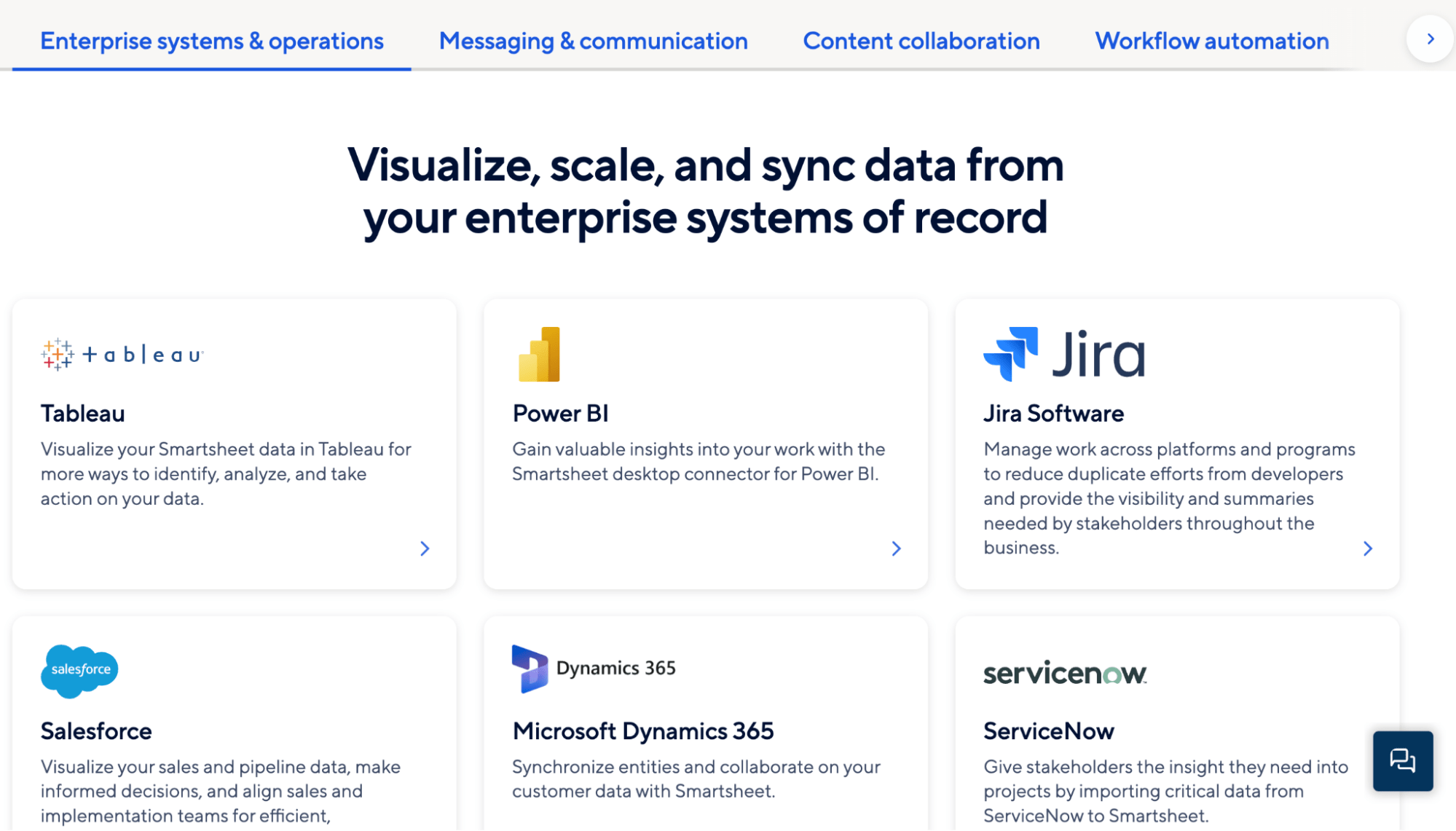
Smartsheet integrates with 100+ third-party applications to help you ease the data analysis and visualization process.
The platform’s integrations are categorized into 5 categories:
Enterprise system and operations: Tableau, Power BI, Jira, Salesforce, etc.
Messaging and communication: Slack, Microsoft Teams, Webex, etc.
Content collaboration: Adobe Creative Cloud, DocuSign, Grammarly, etc.
Workflow automation: Bridge, Zapier, Workato, etc.
Security and governance: Skyhigh Security, Directory integration, Microsoft Defender.
Excel
Excel lacks modern, plug-and-play data integrations, most of which you'd find in Smartsheet and Rows.
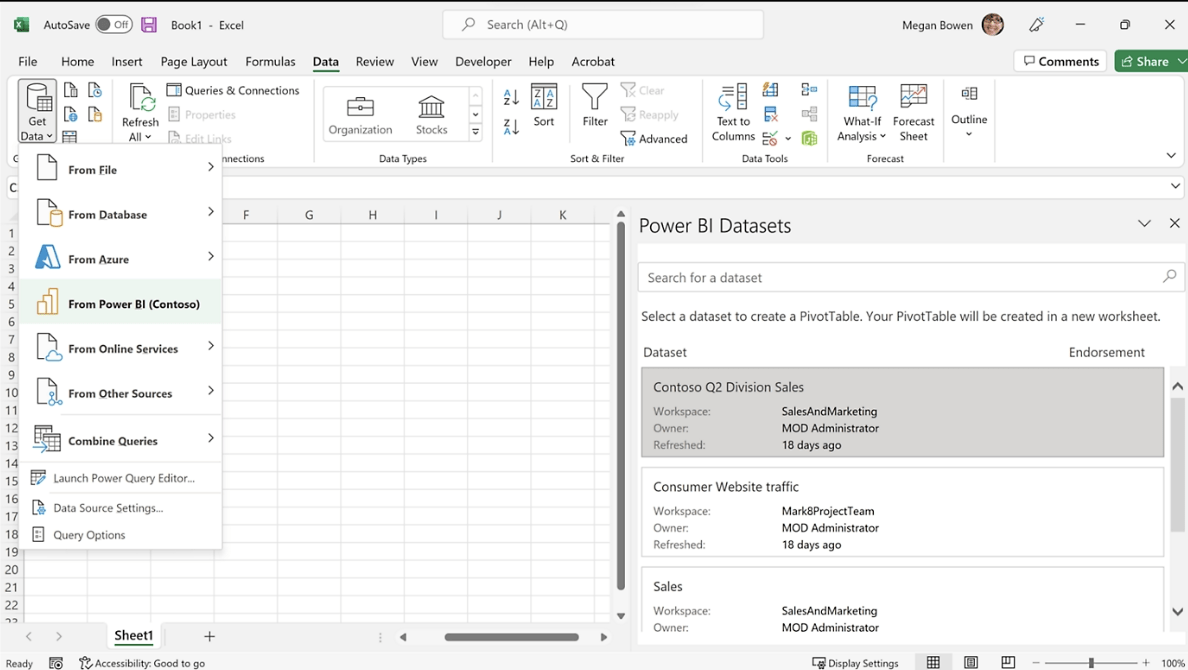
However, Excel offers Zapier integration, allowing you to integrate with 5,000+ apps in a click. The only native integrations Excel has are for Power BI and a few data warehouses.
Pricing: Smartsheet vs Excel vs Rows
Rows
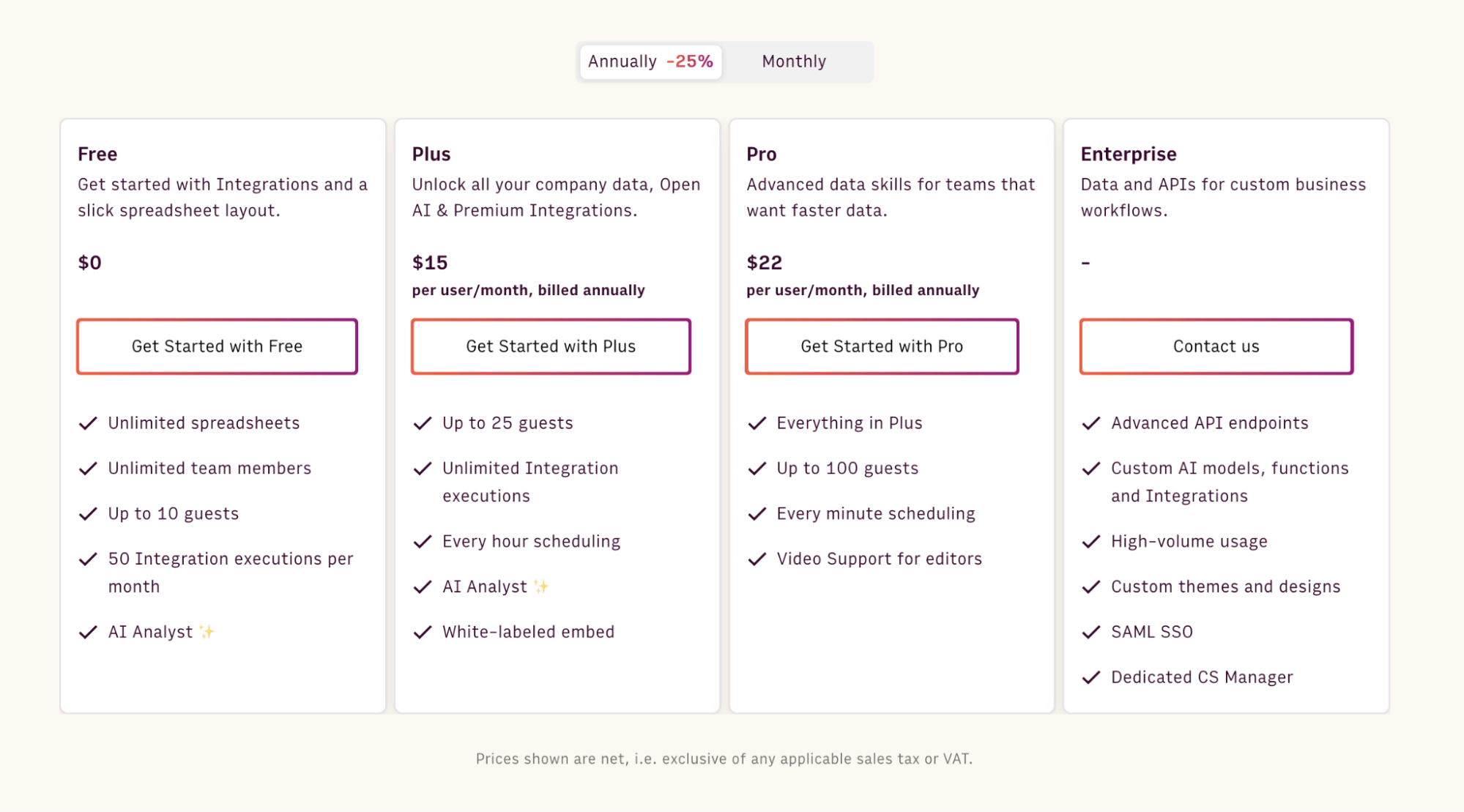
Rows comes with a free forever plan that lets you:
Onboard unlimited team members
Add up to 10 guests
Create unlimited spreadsheets
Execute 50 integration tasks per month
The free plan is quite generous. But if you want to use data integrations at scale, want white-labeled embed, video support, and more, you have the option to upgrade to one of the paid plans Rows offers:
Plus: $15/month/member, up to 25 guests, unlimited integration tasks & daily data refresh.
Pro: $22/month/member, up to 100 guests, unlimited integration tasks & hourly data refresh.
Enterprise: Custom price for advanced API usage and workflows.
Smartsheet
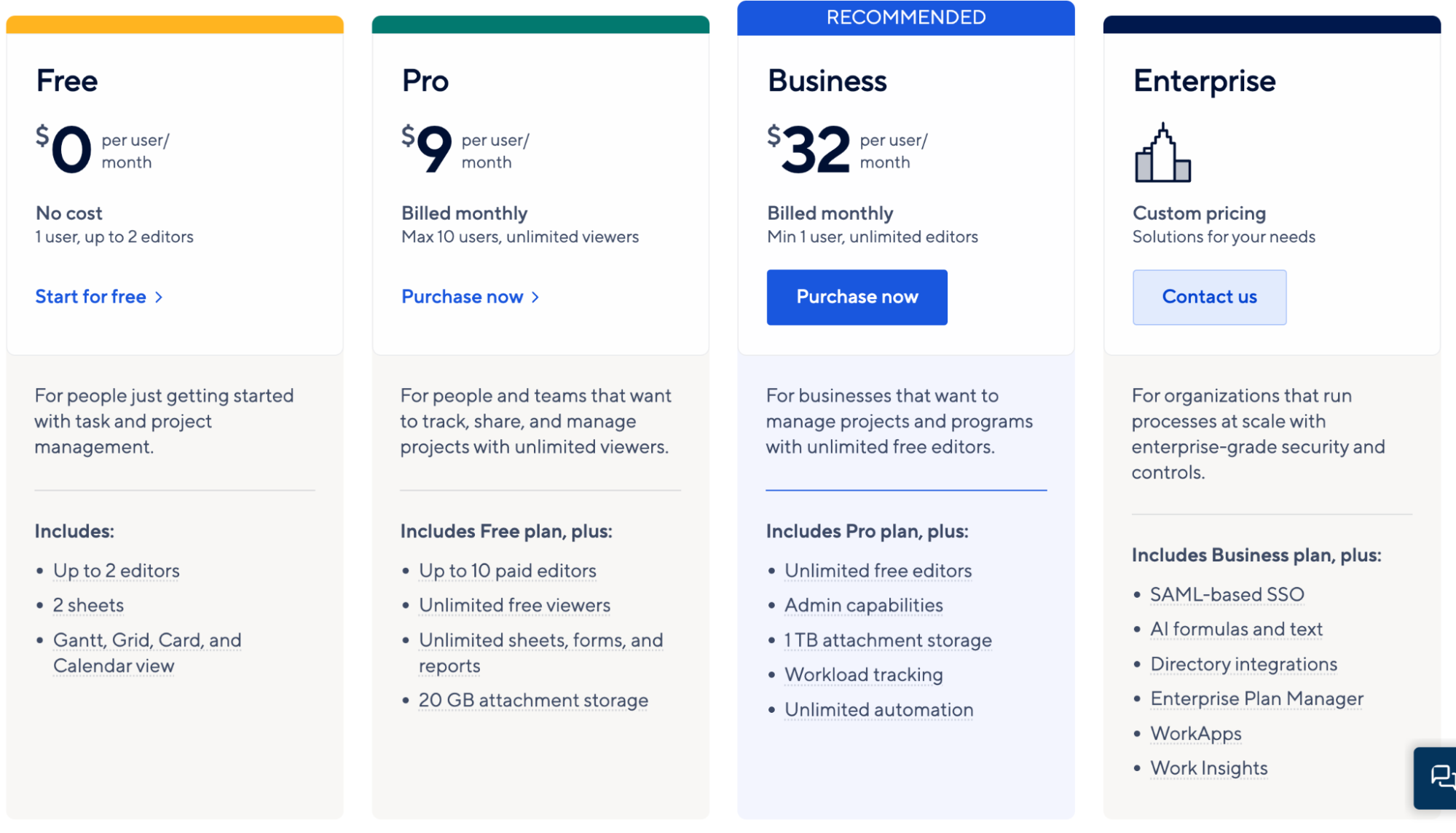
Smartsheet offers a free forever plan limited to 1 user and 3 sheets. Other than that, it has three premium plans:
Pro: $9 per user per month
Business: $32 per user per month
Enterprise: Custom pricing
Excel
Microsoft Excel (web-only) is available as a standalone app and is free for personal use.
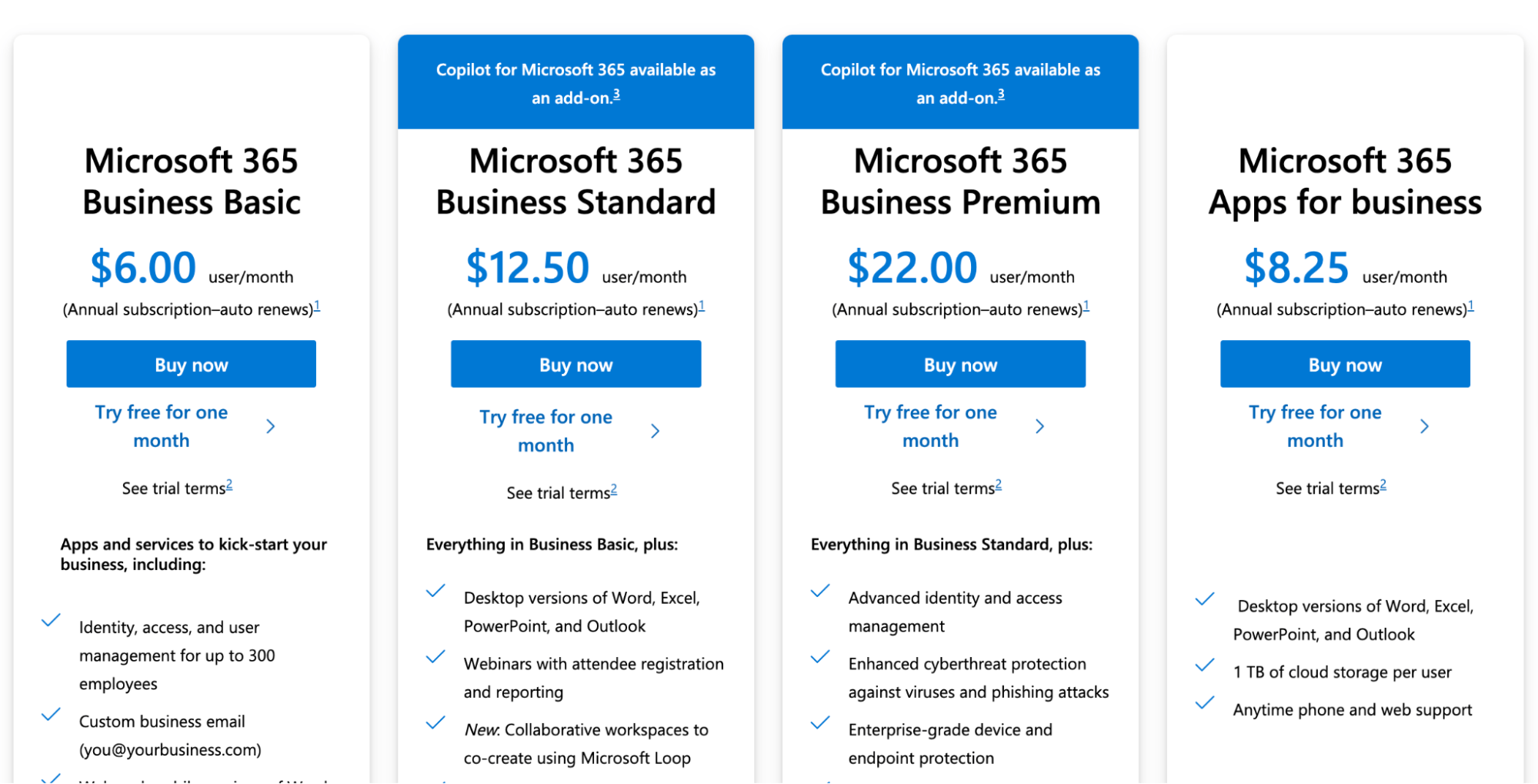
The offline version comes as part of the Microsoft 365 suite and has two subscription categories for personal and professional use:
For Home
Personal: $6.99 per month
Family: $9.99 per month
For Business
Basic: $6 per user per month
Standard: $12.50 per user per month
Premium: $22 per user per month
👀 Note: Copilot AI is available as an add-on.
What are Customers Saying?
Rows
The knowledge base Rows offers for every feature and integration is commendable, and users love it.
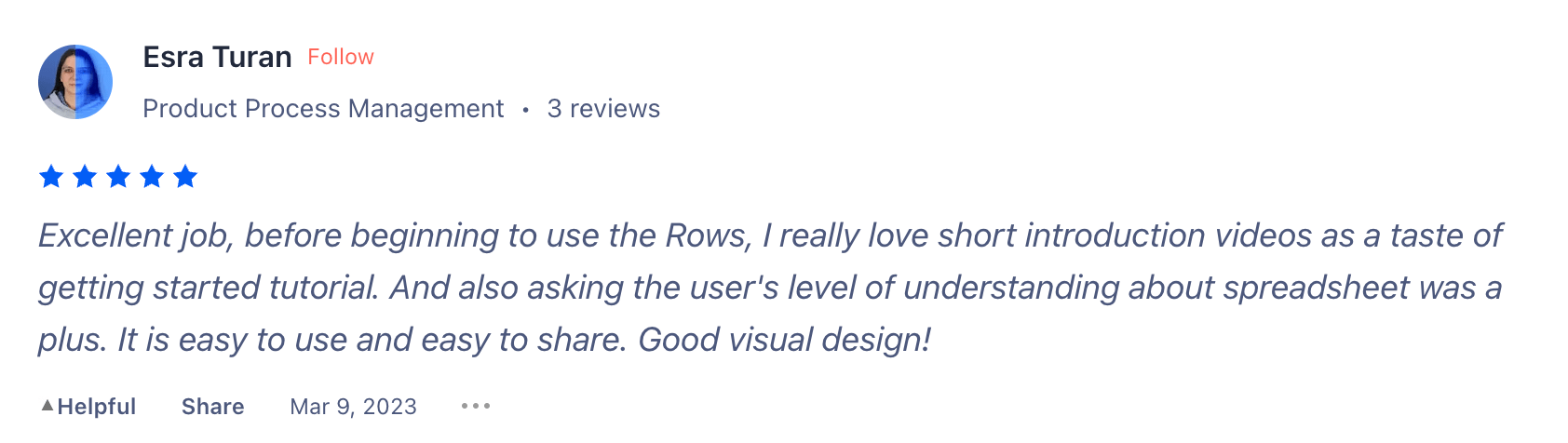
“Excellent job. Before beginning to use the Rows, I really loved short introduction videos as a taste of getting started on the tutorial. Also, asking the user's level of understanding about spreadsheets was a plus. It is easy to use and easy to share. Good visual design!” - Product Hunt.
A large number of integrations makes it easy for users to import and export data.
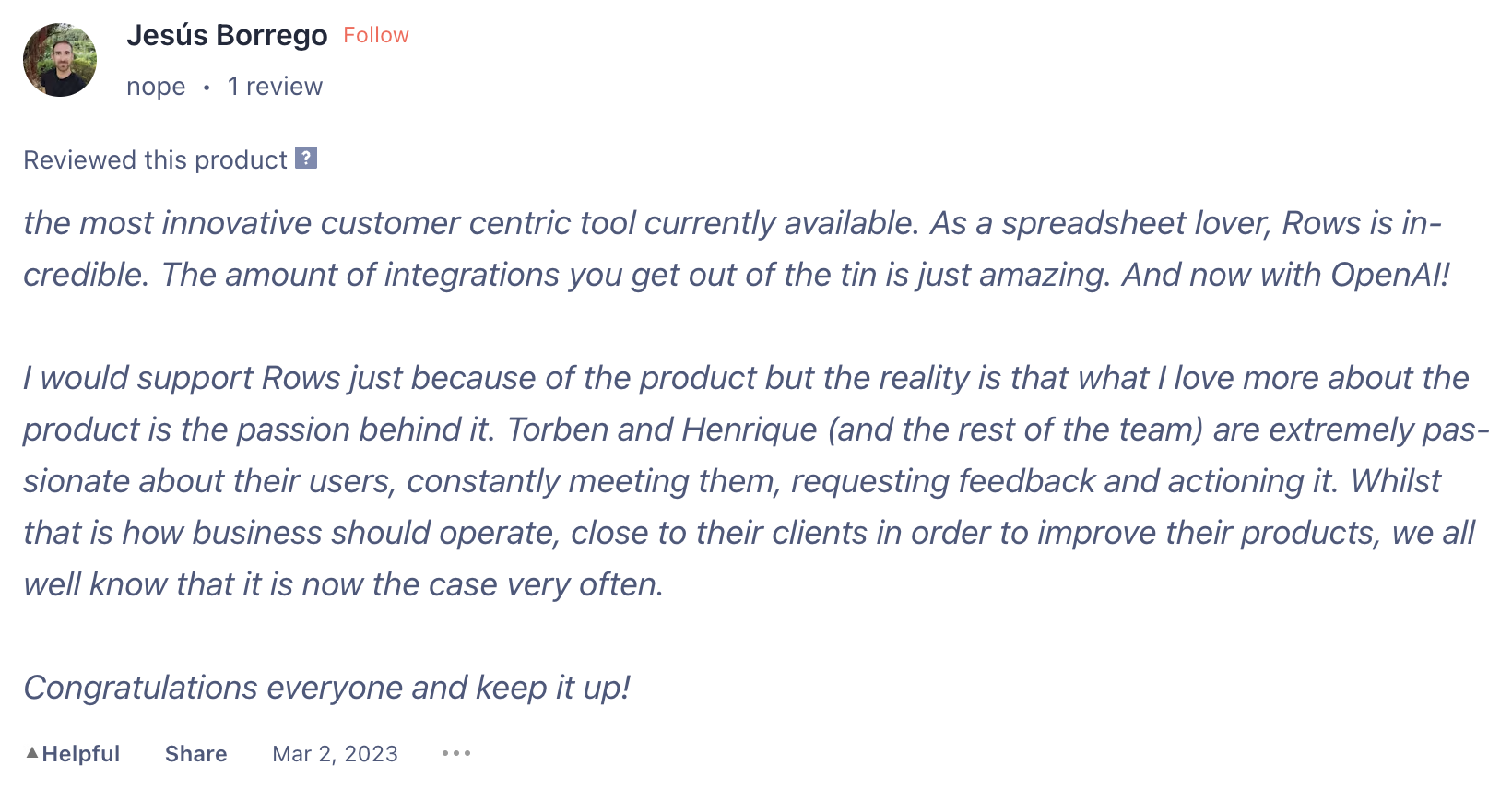
“The most innovative customer-centric tool currently available. As a spreadsheet lover, Rows is incredible. The amount of integrations you get out of the tin is just amazing. And now with OpenAI!
I would support Rows just because of the product but the reality is that what I love more about the product is the passion behind it. Torben and Henrique (and the rest of the team) are extremely passionate about their users, constantly meeting them, requesting feedback and actioning it. Whilst that is how businesses should operate, close to their clients in order to improve their products, we all well know that it is now the case very often.” - Product Hunt.
Your new AI Data Analyst
Extract from PDFs, import your business data, and analyze it using plain language.
Try Rows (no signup)Smartsheet
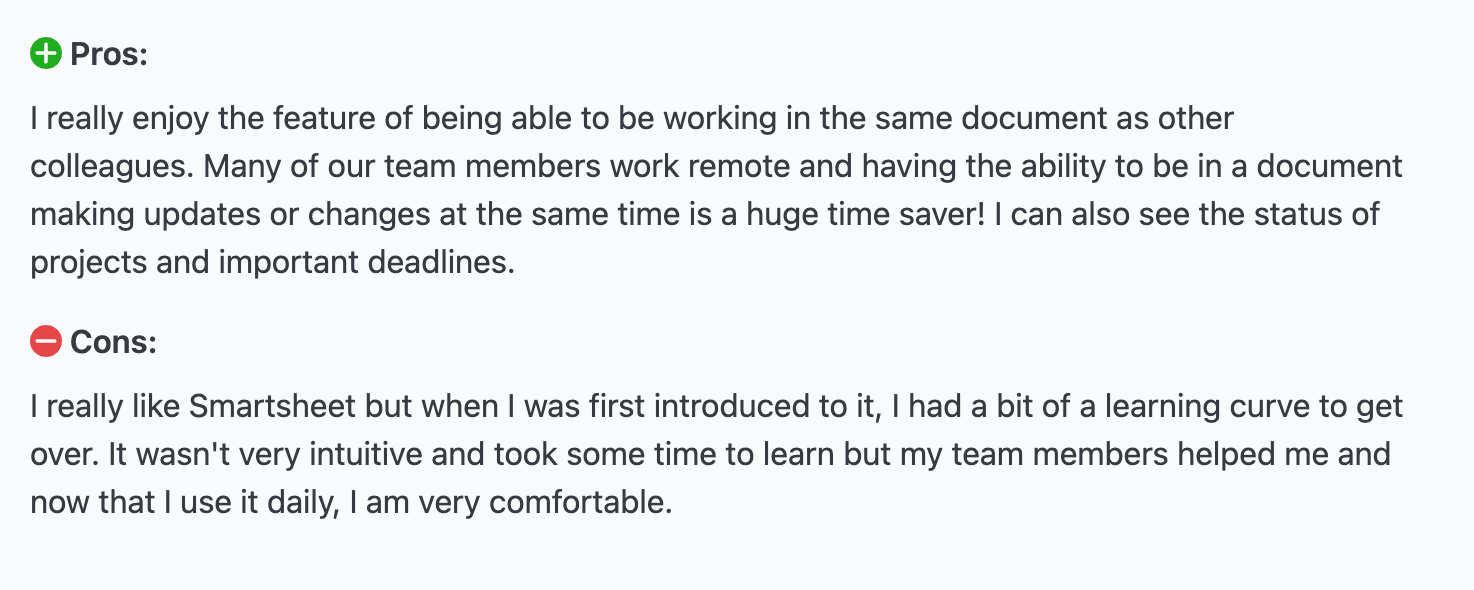
A reviewer from Capterra loves Smartsheet’s collaboration features, but she also observed that the tool has a learning curve.
‘I really enjoy the feature of being able to be working in the same document as other colleagues. Many of our team members work remotely and having the ability to be in a document making updates or changes at the same time is a huge time saver! I can also see the status of projects and important deadlines.
I really like Smartsheet but when I was first introduced to it, I had a bit of a learning curve to get over. It wasn't very intuitive and took some time to learn but my team members helped me and now that I use it daily, I am very comfortable.’
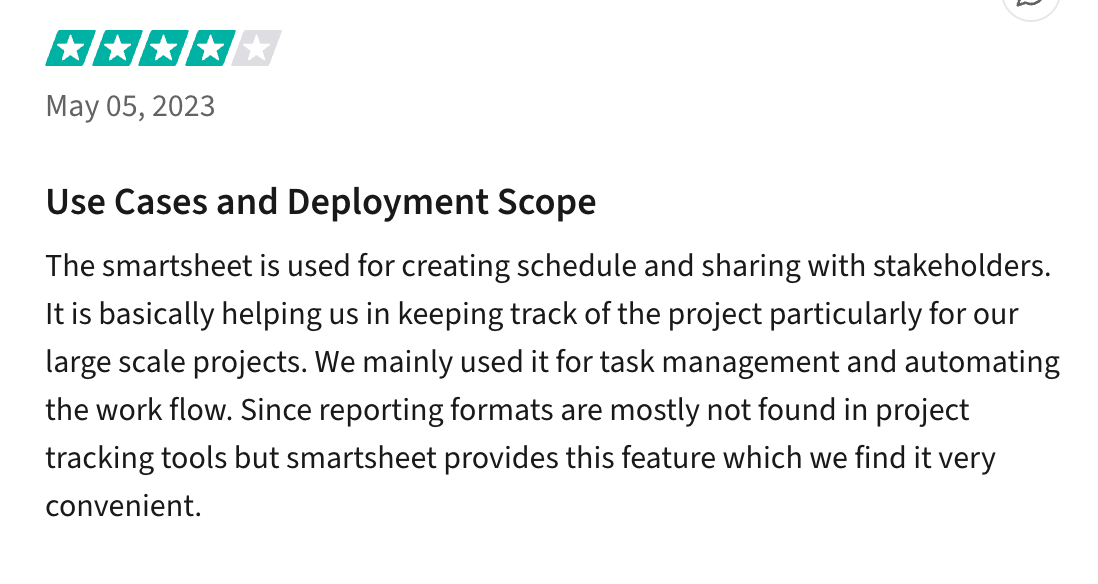
Businesses often use Smartsheet to create schedules and reports to share with stakeholders.
‘The smartsheet is used for creating schedules and sharing with stakeholders. It’s basically helping us in keeping track of the project, particularly for our large-scale projects. We mainly used it for task management and automating the workflow. Since reporting formats are mostly not found in project tracking tools, Smartsheet provides this feature which we find very convenient.’
Excel
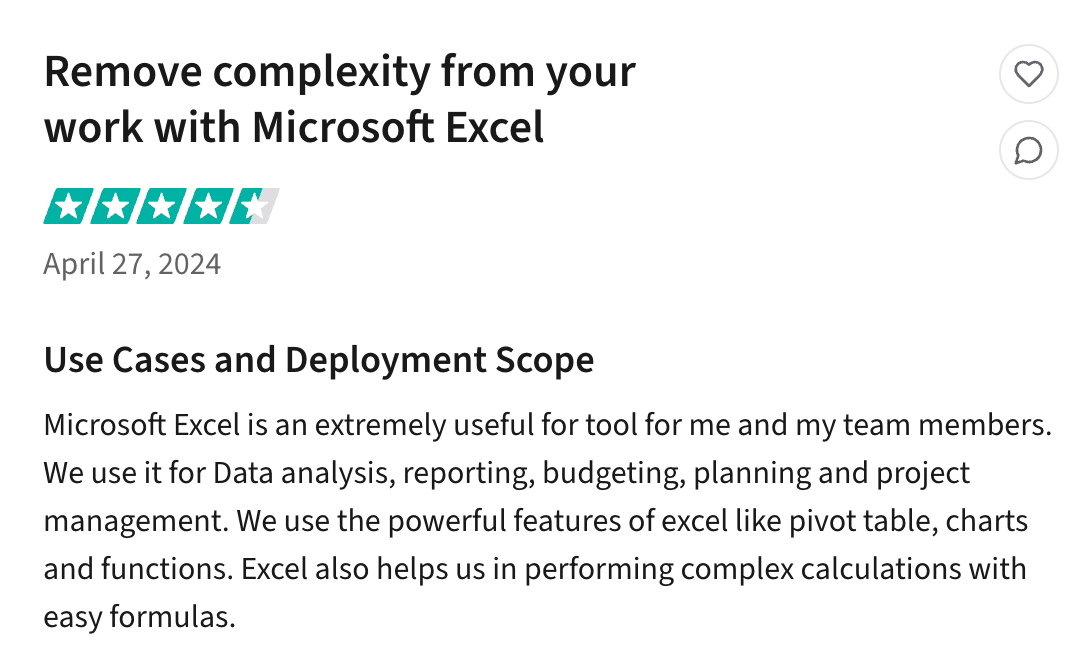
Users use Excel for making pivot tables, charts, and its functions and formulas.
‘Microsoft Excel is an extremely useful tool for me and my team members. We use it for Data analysis, reporting, budgeting, planning, and project management. We use the powerful features of Excel, like pivot tables, charts, and functions. Excel also helps us in performing complex calculations with easy formulas.’
Many users who use Excel complained about the software having a higher learning curve compared to other similar software due to its vast functionalities.
‘Formulas are simple to understand and use. Data is easily visualized. Data is readily organized and sorted.
The greater function requires a larger learning curve. may affect hardware performance based on the volume of data.’
Wrapping Up
One thing is sure – after reading this in-depth comparison guide between Smartsheet, Excel, and Rows, you must have made up your mind about which software is right for you.
Here’s a quick recap:
Rows’ AI capabilities, integrations, and unique features makes it one of the best spreadsheet software in the market. It can help you:
Make data analysis easier by leveraging AI, even for non-data-friendly users.
Build charts, graphs, and more elements that help you with data visualization.
Integrate with data warehouses, finance, marketing, and many more apps to import and export data.
Smartsheet leverages the interface of a spreadsheet to solve project management tasks. It is great for team collaboration and also comes with some AI capabilities similar to Rows.
Excel, the OG of the spreadsheet industry, is apt for handling large datasets and comes with hundreds of functions and formulas that help you do complex calculations.
If you or your team don’t have the time to try all three spreadsheet tools, go to Rows.com, import data, automate your report, and see if it's the right match!
Related Reading